

By News Pulse Desk | May 2, 2026
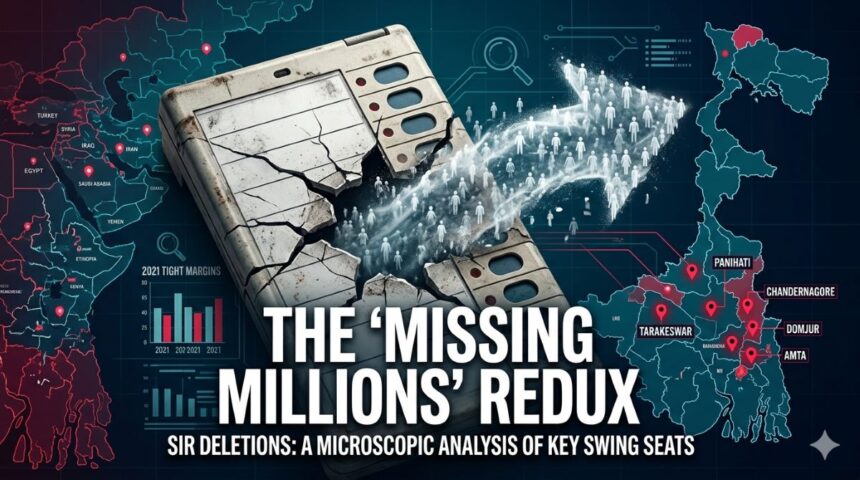
The extraordinarily high voter turnout in the 2026 West Bengal Assembly Election has not silenced the whispers of controversy. In fact, it has only intensified the post-poll discourse surrounding the ‘Missing Millions’ Redux, a critical analysis of how the Special Intensive Revision (SIR) might have reshaped the electoral map.
Prior to the elections, the Election Commission (ECI) executed a comprehensive SIR, removing approximately 9 million voters (about 12% of the electorate) statewide due to “logical discrepancies.” As the state prepares for counting day on May 4, the ‘Missing Millions’ Redux examines a compelling question: In a contest defined by fierce polarization, did these targeted deletions decisively flip key swing seats?
The SIR Factor in Razor-Thin Races
The hypothesis of the ‘Missing Millions’ Redux is that the impact of the SIR was not uniform. Its significance isn’t found in a statewide analysis but in the micro-level examination of constituencies with incredibly tight margins in 2021.
In many of these swing seats, the total number of deleted voters far exceeded the previous victory margin. The ‘Missing Millions’ Redux argues that if these deletions skewed heavily against one party—a theory already being heavily debated as a “Silent Voter” factor—it could easily have manufactured a flip.

Let’s delve into localized data from key districts to explore the potential impact of this electoral roll cleanup.
Spotlighting the Vulnerable Constituencies
The core of this localized analysis focuses on seats where a difference of a few hundred or thousand votes decided the outcome in 2021. The ‘Missing Millions’ Redux is particularly relevant in constituencies across North and South 24 Parganas, Hooghly, and parts of the industrial belt.
1. Panihati (North 24 Parganas)
In 2021, Panihati was a close-contested seat. For 2026, the R.G. Kar tragedy made it symbolic, with the victim’s mother contesting against the TMC. A deep dive by the ‘Missing Millions’ Redux reveals that Panihati saw a massive deletion rate during the SIR, affecting several specific booths. If the deletions disproportionately affected voters motivated by the R.G. Kar sentiment, the ‘Missing Millions’ Redux suggests a significant impact. (Victory Margin 2021: 1,917 | 2026 SIR Deletions: ~7,100).
2. Chandernagore (Hooghly)
Another key urban-semi-urban seat. This constituency features in the ‘Missing Millions’ Redux because the total deletions were more than double the previous victory margin. A swing of just a fraction of the ‘missing millions’ could alter the result, turning this potential Urban Bastion into a Saffron Shift. (Victory Margin 2021: 3,114 | 2026 SIR Deletions: ~8,800).
3. Domjur (Howrah)
This seat, known for high-profile shifts, has always had a volatile electorate. The ‘Missing Millions’ Redux analysis here shows deletion numbers that are astronomical compared to the tight 2021 race. Any skew in the deletions (as high as 12,000) could render the 2021 numbers meaningless. (Victory Margin 2021: 4,140 | 2026 SIR Deletions: ~12,400).
4. Amta (Howrah)
Amta presents a different scenario in the ‘Missing Millions’ Redux—a semi-rural seat with deep localized loyalties. While rural deletions were generally lower than urban ones, in Amta, they still exceeded the 2021 margin, illustrating how localized purges could have unexpected effects outside the metropolis. (Victory Margin 2021: 1,327 | 2026 SIR Deletions: ~3,900).
The Mandate in the Balance
The overarching theme of the ‘Missing Millions’ Redux is that the SIR was not a neutral clerical exercise but a potent variable in a bipolar contest. It created a situation where a ‘missing million’ in a crucial border district or a specific Kolkata ward could carry more electoral weight than a ‘million turnouts’ in a safe seat.
This localized approach is key to understanding the potential for unexpected results in the ‘Missing Millions’ Redux areas. Pollsters who relied on previous voter trends might have missed this shift. The ‘Missing Millions’ Redux provides a framework to analyze potential surprises when the results are announced, as a handful of specific seat results could change the entire narrative from a TMC sweep to a BJP surge, or vice versa.
Statistical Controversy: Post-Poll Impact
Regardless of the outcome, the ‘Missing Millions’ Redux will be central to the post-poll discourse. It raises difficult questions about voter verification, the transparency of roll purges, and the potential for structural factors to influence democratic outcomes.
If multiple key swing seats flip to the party that did not control the state government when the SIR was conducted, the narrative surrounding the ‘Missing Millions’ Redux will become one of structural vulnerability. If the seats remain unchanged, it might be interpreted as a validation of the SIR, which the ECI maintained was essential to purification. The counting day on May 4 will finally provide the definitive data to validate or challenge the central tenets of the ‘Missing Millions’ Redux.

Netai Roy is a journalist and content strategist based in Kolkata, India. With a deep background in digital media, e-commerce, and technology, he reports on daily news, tech updates, personal finance, and emerging digital trends.
Location: Kolkata, West Bengal, India
Focus Areas: Tech News, Business & Finance, Local Developments
Email: contact@netairoy.com