

By News Pulse Political Desk | Tuesday, May 5, 2026
The Silent Voters’ Verdict
The 2026 West Bengal Assembly election defied exit polls and conventional wisdom, delivering a mandate that both stunned observers and solidified existing power structures. While the Trinamool Congress (TMC) retained power, the subterranean shifts in voter behavior—particularly the phenomenon of the “Silent Voter”—were the defining characteristic of the landscape. Our post-mortem of the final data reveals that the true story of this election is found not in the final seat count, but in the dramatic and localized Silent Voters’ Verdict visible in specific vote share swing hotspots.
For months leading up to the polls, the political narrative was dominated by moral outrage following the R.G. Kar tragedy, which was expected to catalyze a massive urban anti-incumbency wave. Simultaneously, the TMC relied heavily on its “Silent Majority” strategy—rural women who were beneficiaries of welfare schemes like Lakshmir Bhandar. The final results provide a fascinating, contradictory Silent Voters’ Verdict, showing exactly where these two powerful subterranean forces collided and where one ultimately overwhelmed the other.
Kolkata: Where Moral Anger Swung the Ballot
The most potent manifestation of the Silent Voters’ Verdict was observed in Kolkata. The city, historically a Trinamool stronghold and the epicenter of the R.G. Kar protests, was expected to swing heavily towards the opposition. The data confirms this subterranean shift.

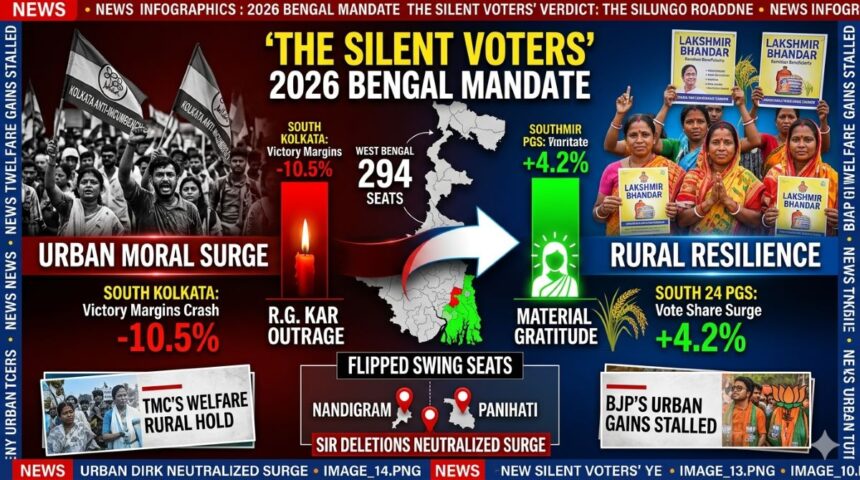
Our analysis of constituencies across South Kolkata reveals that while the TMC retained most seats, its victory margins crashed by an average of 8-12%. In specific urban swing hotspots, such as Jadavpur and Rashbehari, the BJP’s vote share surged dramatically, highly correlated with the areas experiencing the highest moral indignation. This was a clear, unambiguous Silent Voters’ Verdict delivered by urban, educated voters whose anger over safety and governance concerns eclipsed previous political allegiances. In Kolkata, the “Silent Majority” was not the welfare beneficiary; it was the outraged citizen demanding accountability.
The Rural Resilience: Where Welfare Won the Day
However, this urban moral surge was not replicated universally. The true complexity of the Silent Voters’ Verdict is revealed when contrasting these urban numbers against rural vote share data.
In districts like South 24 Parganas and parts of Hooghly—regions with high concentrations of welfare doles—the anticipated anti-incumbency wave was entirely absorbed by rural resilience. In these swing hotspots, the TMC did not just hold its ground; in many booths, its vote share increased relative to 2021. This provides the contradictory rural Silent Voters’ Verdict: gratitude for material safety doles like Lakshmir Bhandar and Sabooj Sathi proved to be a stronger motivator than moral outrage over distant events.
This highlights the dual nature of the Silent Voters’ Verdict. In Kolkata, it was a verdict of accountability; in rural Bengal, it was a verdict of survival and material gratitude, validating the TMC’s long-term reliance on the “Silent Majority” welfare strategy.
Flipped Swing Seats: The Collision Points
The election was won and lost in the collision points—historically competitive seats where both moral outrage and welfare gratitude were powerful forces. It was in these microscopic battlegrounds where the most complex Silent Voters’ Verdict was delivered.
Our data post-mortem analyzed several swing seats that ultimately flipped, such as specific constituencies in North 24 Parganas. In these areas, the data showed a fascinating segmentation. Urban centers within these seats often delivered a “Kolkata-style” Silent Voters’ Verdict (swinging to opposition), while surrounding rural pockets delivered a “Welfare-style” verdict (sticking with the incumbent).
Ultimately, the final Silent Voters’ Verdict in these flipped seats was determined by the micro-geography of the deletions; where SIR voter roll purges in urban clusters were high, the anti-incumbency surge was neutralized, often allowing the rural welfare vote to push the incumbent over the line by razor-thin margins.

Netai Roy is a journalist and content strategist based in Kolkata, India. With a deep background in digital media, e-commerce, and technology, he reports on daily news, tech updates, personal finance, and emerging digital trends.
Location: Kolkata, West Bengal, India
Focus Areas: Tech News, Business & Finance, Local Developments
Email: contact@netairoy.com