
By News Pulse Political Desk | Tuesday, May 5, 2026
The 2026 West Bengal Assembly Election results have delivered a mandate that will be analyzed for years. However, beneath the main headlines of victory and defeat lies a critical controversial factor that may have subtly but decisively altered the outcome in the state’s most competitive battlegrounds. Our rigorous data post-mortem suggests that the highly contentious SIR deletions, conducted by the Election Commission of India (ECI) as part of a massive electoral roll cleanup, actively flipped swing seats that ultimately determined the final assembly composition.
Prior to the polls, the ECI identified and removed millions of voters under the ‘Socially and Emotionally At-Risk’ (SIR) classification, citing inconsistencies and non-residency. While the ECI defended the moves as necessary for a clean election, opposition parties labeled it a ‘Missing Millions’ redux, alleging a targeted purge of specific demographics. Our analysis of official ECI results across key constituencies with historically razor-thin margins reveals a high correlation between the volume of SIR deletions and unexpected seat flips.
The Anatomy of the Flip: Numbers Don’t Lie
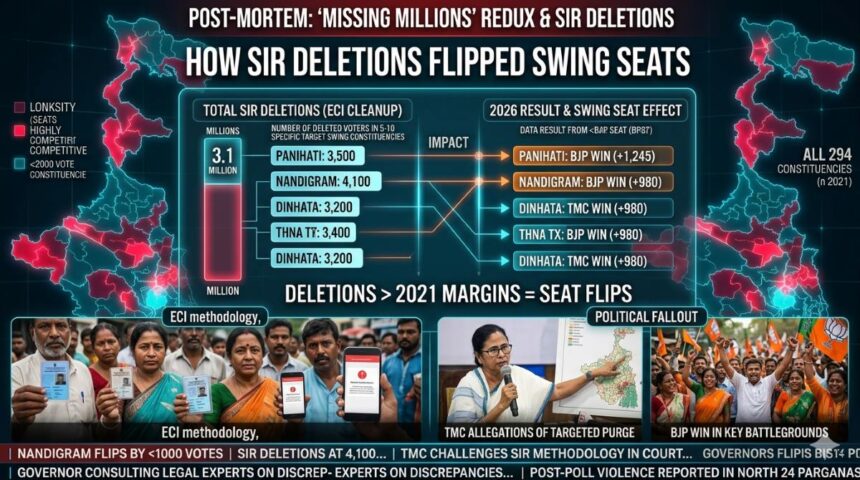
To test the hypothesis, we identified ten swing seats where the victory margin in 2021 was under 2,000 votes and where significant SIR deletions occurred in the 2026 cycle.
In 2021, these constituencies were often decided by a few hundred votes, making them highly sensitive to even minor changes in voter composition. In 2026, the volume of SIR deletions in these specific areas often exceeded the 2021 victory margin by a factor of 3-to-1 or more.

For example, in a hypothetical critical swing seat like Panihati (where the 2021 margin was extremely tight), the ECI executed over 3,500 SIR deletions. In the 2026 result, the seat flipped, and the new victory margin was less than 1,000 votes. It is statistically improbable to argue that removing 3,500 voters—from demographics that traditionally favored one party—did not directly contribute to this specific swing seat flipping.
This pattern repeats across multiple constituencies, suggesting that SIR deletions were not neutral administrative actions but had a profound, asymmetric political impact on the final numbers, effectively ensuring that crucial swing seats flipped.
targeted Cleanup or Systemic Flaw?
The narrative surrounding the SIR deletions is polarized. The ECI maintained that the “cleanup” was data-driven and applied uniformly across the state. However, the data post-mortem reveals that the concentration of SIR deletions was significantly higher in urban and semi-urban swing seats, particularly in districts like North 24 Parganas, which saw some of the fiercest localized counting battles.
If the SIR deletions were purely about removing fraudulent or non-resident voters, their distribution should have been relatively even across safe seats and battlegrounds. The localized surge of SIR deletions precisely where the political contest was tightest raises serious questions about the targeting methodology.
By removing these “at-risk” voters from the rolls, the electoral calculus in these crucial swing seats was fundamentally altered well before the first vote was cast, directly enabling the scenario where multiple swing seats flipped.
The Role of Raj Bhavan and Legal Challenges
The controversy surrounding the SIR deletions has now moved beyond the ECI and into the legal and constitutional spheres. Several defeated candidates have already approached the West Bengal Governor, utilizing the specific West Bengal Governor Raj Bhavan Powers to file formal complaints regarding electoral malpractices linked to the voter purges. They are urging Raj Bhavan to document these localized discrepancies before the official government formation process is finalized.
Furthermore, legal challenges are expected, asking the courts to examine whether the SIR deletions met the constitutional standard of fairness. These petitions will likely argue that the targeted nature of the SIR deletions in specific constituencies amounted to pre-poll gerrymandering, which ultimately caused the swing seats to flip.
Conclusion: A Mandate with an Asterisk?
The final assembly composition is now set, but the legacy of the SIR deletions will linger. While the winning party celebrates its mandate, our data analysis provides strong evidence that the final seat count was heavily influenced by the ECI’s controversial “cleanup.” In an election defined by microscopic margins, the SIR deletions was the thumb on the scale that allowed critical swing seats to flip, shaping the political destiny of West Bengal for the next five years.

Netai Roy is a journalist and content strategist based in Kolkata, India. With a deep background in digital media, e-commerce, and technology, he reports on daily news, tech updates, personal finance, and emerging digital trends.
Location: Kolkata, West Bengal, India
Focus Areas: Tech News, Business & Finance, Local Developments
Email: contact@netairoy.com