

By News Pulse Political Desk | Tuesday, May 6, 2026
How the Bengal result shapes national politics 2026
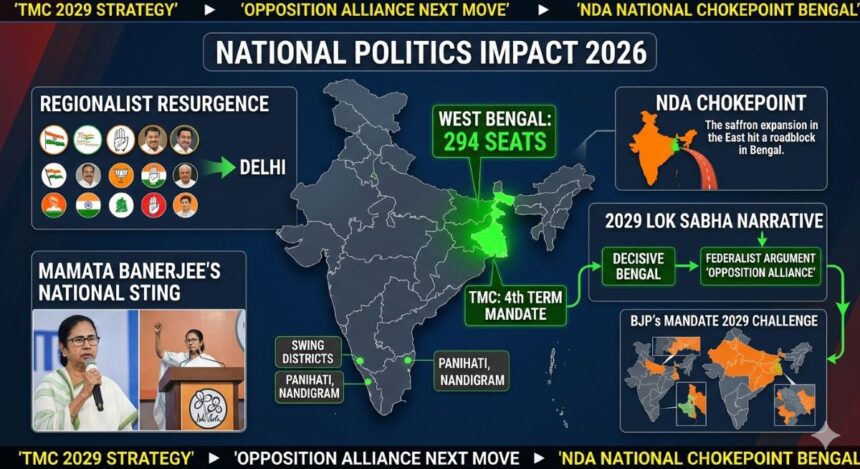
The extraordinarily high-stakes 2026 West Bengal Assembly Election has concluded, with the Trinamool Congress (TMC) securing a historic fourth consecutive term. While the immediate focus remains on government formation logistics at Raj Bhavan, the tectonic echoes of this mandate extend far beyond the 294 seats of the state assembly. The definitive verdict in Kolkata is already recalibrating the strategic calculus of every major political player in India. Understanding exactly how the Bengal result shapes national politics 2026 is essential to decoding the roadmap for the 2029 Lok Sabha elections.
This election was never just about West Bengal; it was a microscopic battle with macroscopic consequences. The TMC’s ability to withstand the full might of the BJP’s national machinery provides a definitive template for regional resistance, directly influencing how the Bengal result shapes national politics 2026 by fortifying federalist narratives across the country.
1. The Regionalist Resurgence and the Federalist Friction
The most immediate answer to how the Bengal result shapes national politics 2026 lies in the renewed confidence of regional satraps. Mamata Banerjee’s victory, achieved by framing the contest as ‘Bengal’s Daughter vs. Delhi’s Outsiders,’ validates a potent model of linguistic and cultural nationalism. This model will now be exported.
Parties like the DMK in Tamil Nadu, the Shiv Sena (UBT) in Maharashtra, and the JMM in Jharkhand will see this as confirmation that a strong localized narrative can neutralize the BJP’s centralized ‘One Nation, One Election’ pitch. This is crucial to how the Bengal result shapes national politics 2026; it ensures that Federalism will replace Hindutva as the primary ideological battleground leading up to 2029. We can expect an immediate surge in regional demands for greater fiscal autonomy and resistance to central agency interventions, all catalyzed by the knowledge of how the Bengal result shapes national politics 2026.

2. A Checkpoint on the ‘Saffron Shift’ in the East
For the BJP, the Bengal outcome is a significant strategic speedbump. The party had invested unprecedented resources to complete its “Saffron Shift” in Eastern India, aiming to pair Bengal with its strongholds in Assam and Odisha. The failure to capture Nabanna forces a national-level re-evaluation.
This is a pivotal factor in how the Bengal result shapes national politics 2026. The ideological project of integrating Bengal into the Hindi-Heartland narrative has been stalled. The BJP must now acknowledge that deep-rooted cultural sub-nationalism remains a formidable barrier. The national fallout is that the BJP may shift its immediate focus away from aggressive expansion in the East and instead concentrate on consolidating its base in the West and North, directly influencing how the Bengal result shapes national politics 2026.
3. Recalibrating the Opposition Alliance (I.N.D.I.A.)
Perhaps the most dramatic way how the Bengal result shapes national politics 2026 is through its impact on Opposition unity. Mamata Banerjee is no longer just one of many regional leaders; she is now arguably the single most successful anti-BJP crusader in the country.
This reality completely alters the internal power dynamics of the I.N.D.I.A. alliance. The TMC will demand a much larger, perhaps even dominant, role in determining the alliance’s national strategy. The Congress party, which struggled significantly in this election, must now accept a diminished status relative to the TMC. This shift is central to how the Bengal result shapes national politics 2026; it makes the emergence of a non-Congress alternative to lead the Opposition a distinct possibility for 2029. The question of who leads the fight against Prime Minister Modi is irrevocably tied to how the Bengal result shapes national politics 2026.
Conclusion: Setting the Stage for 2029
The 2026 mandate is the definitive opening bell for the 2029 Lok Sabha cycle. The core issues that defined the Bengal contest—welfare populism vs. development, regional identity vs. national integration, and the role of constitutional authorities—have now been mainstreamed nationally.
Ultimately, how the Bengal result shapes national politics 2026 is by proving that the BJP is not invincible when faced with a unified, strong-willed regional opponent. It has energized federalist forces, forced a strategic reset from the saffron party, and crowned a new potential queenmaker (or queen) for national politics. Every political event between now and the next general election will be viewed through the prism of how the Bengal result shapes national politics 2026.

Netai Roy is a journalist and content strategist based in Kolkata, India. With a deep background in digital media, e-commerce, and technology, he reports on daily news, tech updates, personal finance, and emerging digital trends.
Location: Kolkata, West Bengal, India
Focus Areas: Tech News, Business & Finance, Local Developments
Email: contact@netairoy.com