
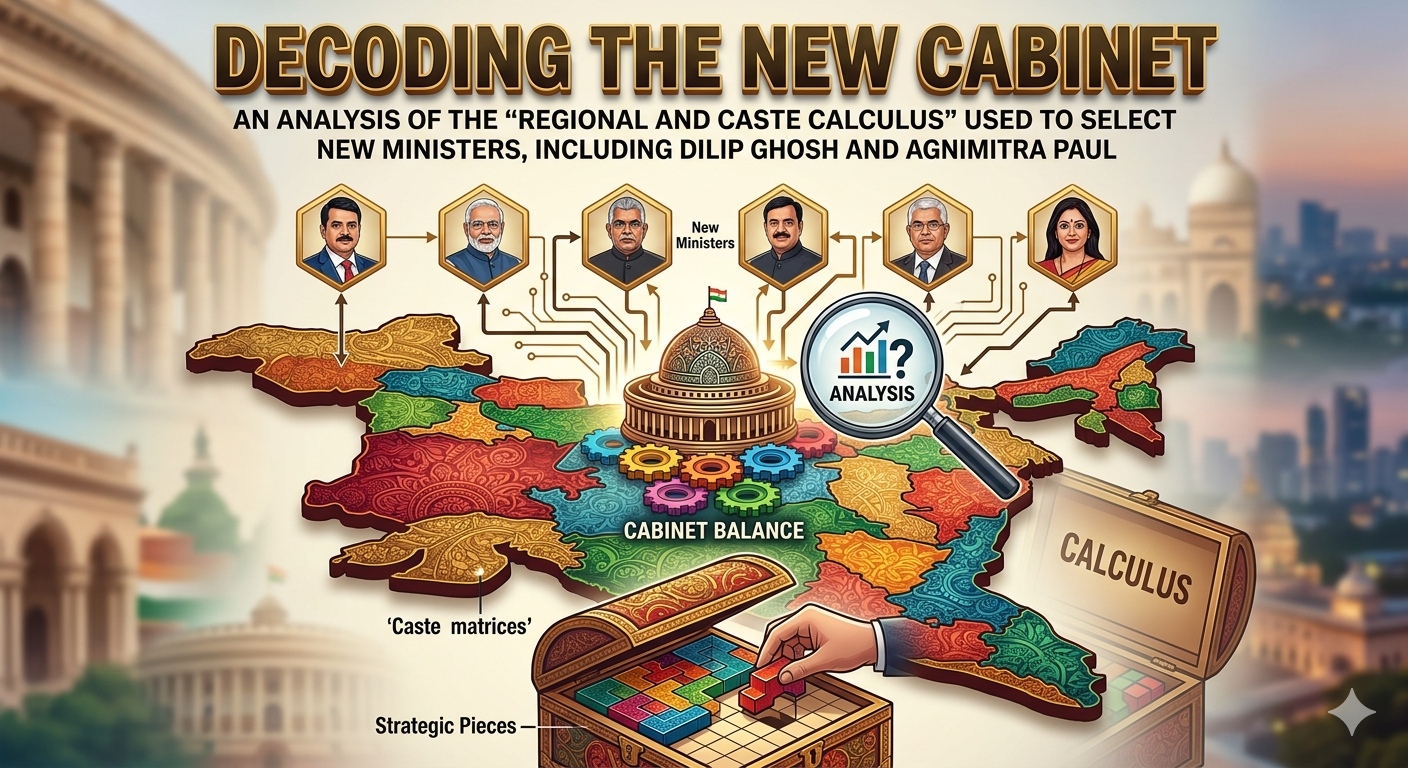

The formation or reshuffling of any cabinet in a large, democratic nation is rarely just about individual merit or perceived expertise. It is a complex, high-stakes game of political chess, where every move is calculated to maximize electoral advantage, reward loyalty, and, most importantly, balance competing interests. In the Indian context, this delicate balancing act is frequently defined by what political scientists and commentators call the regional and caste calculus. The recent cabinet announcement, which saw the induction of figures such as Dilip Ghosh and Agnimitra Paul, provides a fascinating case study in how these deep-seated factors shape the very apex of executive power.
This article provides an in-depth analysis of the regional and caste calculus used to select the new ministers in the recent cabinet formation. We will explore how geographic distribution and community representation were prioritized, often over raw experience, to craft a cabinet that is as much an electoral machine as it is a governing body. The regional and caste calculus is not a modern aberration; it is a foundational, if sometimes uncomfortable, element of modern Indian statecraft.
The Foundations: Understanding the Regional and Caste Calculus
At its core, the regional and caste calculus is a strategy of symbolic representation. For a government to be seen as legitimate and inclusive, it must reflect the myriad identities that make up the nation’s social fabric. This imperative is driven by both ideological commitment and, perhaps more significantly, the cold, hard logic of electoral survival.
The regional calculus ensures that different parts of the country—from the remote northeast to the industrial south—feel they have a voice and a stake in the central government. Ignoring entire regions can lead to political alienation and provide a fertile ground for opposition parties to build regionalist movements. The caste calculus, meanwhile, addresses the deeply entrenched social hierarchies that continue to influence voting behavior. By appointing ministers from diverse caste backgrounds, particularly from marginalized or politically crucial communities, a party signals its commitment to social justice and, critically, solidifies its vote bank.
An analysis of the regional and caste calculus used to select the new ministers requires looking beyond the headlines. We must examine the microscopic details of why specific individuals were chosen from specific regions and how their caste identity factors into the party’s broader national narrative. For example, did the appointments help shore up support in a state facing an upcoming election? Did they assuage the demands of a long-allied but recently distant community?

The Dilip Ghosh Factor: Navigating the Bengal Chessboard
One of the most talked-about decisions in the recent reshuffle was the positioning of Dilip Ghosh. The former BJP West Bengal President is a powerful, polarizing figure, and his role in the cabinet is a masterclass in applying the regional and caste calculus.
From a regional calculus perspective, Ghosh’s inclusion is a clear statement that the party’s focus on West Bengal remains undiminished. Despite the loss in the state assembly elections, Bengal is critical to national electoral arithmetic, contributing 42 seats to the Lok Sabha. The appointment of a grassroots leader like Ghosh ensures that the party’s organization in the state remains energized and that the demands and grievances of Bengal continue to find representation at the highest level. It is a classic move to avoid the perception that the center has abandoned the state after an electoral defeat.
Simultaneously, the caste calculus comes into play. While the specific intricate details of a leader’s caste may not always be the sole driver, Ghosh’s profile as a ground-level organizational man who built the party in Bengal speaks to a form of representation that transcends mere caste identity, yet is informed by it. He represents a robust, assertive form of ideology that resonates with a specific, and crucial, voter demographic in the state. An analysis of the regional and caste calculus used to select the new ministers cannot ignore how powerful personalities, rooted in their regional soil, are strategically deployed.
Furthermore, Ghosh’s positioning allows the party to manage internal state politics. In a state with multiple factions, placing a strongman like Ghosh in the central cabinet both acknowledges his power and provides a mechanism to coordinate—or perhaps control—state-level operations from Delhi. This dual-use capability is what makes the regional and caste calculus so potent when executed skillfully.
Agnimitra Paul and the Urban-Semi-Urban Balance
The appointment of Agnimitra Paul further enriches our analysis of the regional and caste calculus used to select the new ministers. Paul, who represents the Asansol South constituency in the West Bengal Legislative Assembly, brings a different dimension to the cabinet table.
From a regional calculus standpoint, Paul represents an important part of industrial, semi-urban Bengal. While Kolkata dominates the political narrative, the industrial belts like Asansol-Durgapur are critical for winning elections in the state. They have unique economic and social dynamics, and having a representative from this region ensures that their issues—such as industrial decline, labor relations, and civic infrastructure—are given due consideration. Paul’s position ensures a better regional calculus by giving a voice to this non-metropolitan, yet strategically vital, region of Bengal.
But the caste calculus also plays a significant role in her selection. Paul belongs to the Brahmin community. While the caste dynamics in Bengal are sometimes seen as different from states like Uttar Pradesh or Bihar, they remain undeniably significant. Including a high-caste, professional woman (Paul is also a well-known fashion designer) allows the party to articulate an inclusive image that caters to a particular urban and aspirational demographic. It is a carefully curated blend of modernity and tradition, urban appeal, and caste representation. An effective regional and caste calculus is rarely just about filling quotas; it’s about crafting a mosaic that reflects multiple aspirations.
Her inclusion also subtly balances Dilip Ghosh’s profile. While Ghosh is often seen as a fiery, grassroots leader with a strong base in rural and semi-urban Bengal, Paul provides a contrast as an articulate, professional woman from an industrial-urban constituency. Together, they represent a broader cross-section of the Bengal electorate, strengthening the party’s overall regional calculus for the state.
The Broad, Nationwide Picture: Reaching Every Corner
The regional and caste calculus observed in the Bengal appointments was replicated across the nation. In Uttar Pradesh, for instance, a state with complex caste matrices and 80 Lok Sabha seats, the selection of new ministers was meticulously engineered. An analysis of the regional and caste calculus used to select the new ministers in UP reveals a strategic focus on OBC (Other Backward Classes) and Dalit communities. This was not just about increasing their raw numbers in the cabinet, but about sending a strong symbolic message to specific sub-castes within these large groups whose allegiance can make or break an election.
Similarly, the selection of ministers from the Northeast reflects a robust regional calculus. For decades, the region felt marginalized by Delhi, but recent cabinets have prioritized its representation. The appointments here are about more than just numbers; they are about including leaders from diverse tribes and ethnic groups, signaling a commitment to a truly integrated national polity. A precise regional and caste calculus is essential to managing the intricate ethnic and regional diversity of the Northeast.
In states like Karnataka and Maharashtra, the regional and caste calculus had to navigate powerful, established caste-based pressure groups, such as the Lingayats and Vokkaligas in Karnataka, and the Marathas in Maharashtra. In these regions, the cabinet reshuffle was used as a tool to assuage some groups while carefully balancing the representation of others, all with an eye on the next electoral cycle. A shallow analysis might miss these nuances, but an in-depth analysis of the regional and caste calculus used to select the new ministers reveals that no appointment is arbitrary.
The selection process, therefore, is a fine-tuning of this national mosaic. If a powerful region saw its representation reduced, it was likely to appease the caste-based demands of another politically critical state. If a specific caste group was given prominence, it was often with a clear regional objective in mind. This intricate, almost mathematical, application of the regional and caste calculus is what allows a political party to maintain its grip on power across such a vast and diverse nation.
The Critics’ Perspective: Merit vs. Representation
This inescapable reliance on the regional and caste calculus is not without its critics. Opponents and some political observers argue that prioritizing geographic and community representation over pure competence can lead to a less effective government. They contend that the cabinet should be composed of the absolute best minds, regardless of where they come from or what community they belong to. They suggest that the regional and caste calculus inherently promotes identity politics and deepens societal divisions.
However, defenders of the system argue that representation is a crucial form of merit in itself, in a diverse democracy. For them, a government that does not look like the people it governs is not a government for all the people. They maintain that true regional and caste calculus is a powerful tool for social justice, ensuring that marginalized communities and neglected regions are given a seat at the highest decision-making table. A minister’s unique regional and social background, they argue, provides invaluable perspectives that are necessary for effective governance in a nation of unparalleled diversity. Furthermore, they argue that ignoring the regional and caste calculus would lead to a more unstable and less harmonious political environment, which would be ultimately detrimental to effective governance.
Beyond Dilip Ghosh and Agnimitra Paul: The Evolution of the Calculus
While Dilip Ghosh and Agnimitra Paul offer clear examples of this political art form, they are part of a much larger, evolving pattern. An analysis of the regional and caste calculus used to select the new ministers over the years shows that the calculus is not static. As economic patterns shift, urban areas grow, and social dynamics change, so too must the political strategies that govern representation.
The rising importance of a professional, educated middle class from non-metropolitan areas is a key new variable in the equation. Ministers like Paul, who blend a professional background with political service, are becoming increasingly common. The caste calculus, too, is becoming more granular, with political parties targeting smaller, hitherto neglected sub-castes to build an electoral coalition.
Furthermore, the introduction of women and younger leaders is adding new dimensions. While these can be seen as forms of symbolic representation, they also represent a strategic response to a changing electorate where women and youth are increasingly asserting their political agency. These are not just add-ons to the regional and caste calculus, but are becoming integral to its very formulation.
In conclusion, the new cabinet is a testament to the enduring power of the regional and caste calculus in Indian politics. The meticulous selection of ministers, including Dilip Ghosh and Agnimitra Paul, was a carefully calibrated move to maintain political stability and maximize electoral advantage. While critics may debate the implications of this strategy on the efficiency of governance, its centrality to Indian statecraft remains undeniable. The regional and caste calculus is the prism through which Indian democracy negotiates power and representation, and its subtle, complex workings will continue to shape the nation’s political landscape for the foreseeable future.
West Bengal Government Cabinet

Netai Roy is a journalist and content strategist based in Kolkata, India. With a deep background in digital media, e-commerce, and technology, he reports on daily news, tech updates, personal finance, and emerging digital trends.
Location: Kolkata, West Bengal, India
Focus Areas: Tech News, Business & Finance, Local Developments
Email: contact@netairoy.com





