

On May 9, 2026, the political geography of Eastern India shifted permanently. As Suvendu Adhikari stood on the dais at Raj Bhavan to take his oath, he didn’t just become the Chief Minister; he became the architect of a promised “Sonar Bangla.” With a decisive mandate of 207 seats in the 294-member assembly, the BJP has successfully ended over a decade of Trinamool Congress rule. However, the honeymoon period for the new administration is non-existent. The state’s eyes are now fixed on the first 100 days of CM Suvendu Adhikari, a period that will define whether the “double engine” government can deliver on its gargantuan promises.
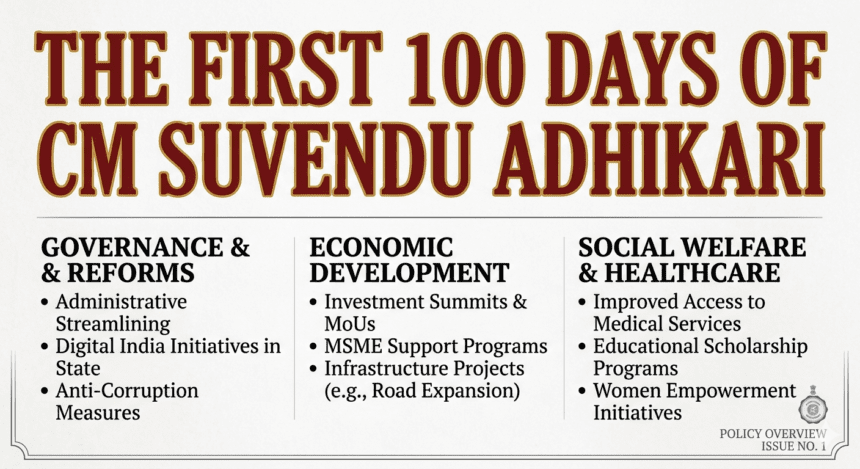
This deep dive explores the logistical, economic, and social pillars that will form the backbone of the first 100 days of CM Suvendu Adhikari.
1. Restoring Administrative Trust: The Seventh Pay Commission
The most immediate hurdle facing the new government is the deep-seated resentment within the state bureaucracy regarding the Dearness Allowance (DA) disparity. During the first 100 days of CM Suvendu Adhikari, the implementation of the Seventh Pay Commission is not merely an economic goal—it is a political necessity to ensure the cooperation of the state’s administrative machinery.
The BJP manifesto, Bhoroshar Shopoth, explicitly promised to clear all DA arrears within the first two months. By focusing on this in the first 100 days of CM Suvendu Adhikari, the Chief Minister aims to signal that the days of “street-fighting politics” within government offices are over. This move is expected to cost the state exchequer billions, but the administration intends to offset this by plugging leakages in previous welfare delivery systems.
2. Nari Surokkha and the Evolution of Welfare
Critics often argued that the BJP would struggle to match the TMC’s popular welfare schemes. To counter this, the first 100 days of CM Suvendu Adhikari will see the launch of the ‘Annapurna’ scheme—a direct evolution of previous doles. By promising ₹3,000 monthly to every woman in the state, the Adhikari administration is effectively doubling the financial support previously offered.

However, the first 100 days of CM Suvendu Adhikari will also focus on a more robust security framework. The “Durga Surokkha Squads,” a proposed specialized female police unit, are slated to be deployed in every district within this 100-day window. For a state still reeling from the moral shock of the R.G. Kar incident, these security measures are the most scrutinized aspect of the first 100 days of CM Suvendu Adhikari.
3. The “Zero Tolerance” Legislative Agenda: UCC and Infiltration
One of the most controversial yet core pillars of the BJP’s mandate is the cultural and legislative reset. Within the first 100 days of CM Suvendu Adhikari, the state assembly is expected to witness the introduction of a resolution for the Uniform Civil Code (UCC). While implementation takes time, the symbolic introduction of the bill within this timeframe is a key priority for the first 100 days of CM Suvendu Adhikari.
Furthermore, the Chief Minister has signaled a “hard-line” approach to border security. Coordinating with the Ministry of Home Affairs in New Delhi, the first 100 days of CM Suvendu Adhikari will involve a massive audit of the “Missing Millions”—a reference to the voter roll discrepancies and the SIR deletions that characterized the 2026 election cycle. The goal is to establish a “Clean Roll” before the next municipal elections.
4. Industrial Renaissance: Ending the “Syndicate Culture”
West Bengal’s economic stagnation has been its Achilles’ heel for decades. The first 100 days of CM Suvendu Adhikari are being framed as a period of “Economic De-clogging.” The most significant policy shift expected is the complete dismantling of the “syndicate” system that has historically controlled construction and local commerce.
By introducing a single-window clearance system that bypasses local political intermediaries, the first 100 days of CM Suvendu Adhikari seek to attract massive private investment. The revival of Singur as an industrial hub, rather than a political graveyard, is a high-priority symbolic project. If the Chief Minister can lay the foundation stone for a major manufacturing plant within the first 100 days of CM Suvendu Adhikari, it would signal to national investors that Bengal is finally open for business.
5. Healthcare and the Ayushman Bharat Integration
For years, the previous administration’s “Swasthya Sathi” was at odds with the Central Government’s Ayushman Bharat. In the first 100 days of CM Suvendu Adhikari, the two schemes are expected to be merged, or the central scheme will be fully implemented. This will provide Bengal’s citizens with access to over 27,000 empanelled hospitals across India.
The first 100 days of CM Suvendu Adhikari will also see a massive audit of the state’s medical colleges. Following the protests of late 2025 and early 2026, the new Health Minister (predicted to be a veteran like Samik Bhattacharya or Agnimitra Paul) will be tasked with implementing the “Transparent Referral System” to end corruption in bed allocations—a cornerstone of the first 100 days of CM Suvendu Adhikari‘s healthcare reform.
6. Education and Merit-Based Recruitment
The “Teacher Recruitment Scam” was a primary driver of the anti-incumbency wave. Consequently, the first 100 days of CM Suvendu Adhikari will focus on clearing the backlog of judicial cases regarding past recruitments and announcing a fresh, centralized, and digital recruitment drive for 50,000 teachers.
By utilizing AI-driven monitoring and central oversight, the first 100 days of CM Suvendu Adhikari aim to prove that government jobs can be secured without “cut-money.” This is crucial for winning over the youth demographic that remained skeptical during the campaign.
7. Infrastructure and the “Sonar Bangla” Connectivity
Connectivity remains a key theme. The first 100 days of CM Suvendu Adhikari will likely accelerate the land acquisition process for the long-delayed ‘Deep Sea Port’ at Tajpur and the expansion of the Bagdogra International Airport. By aligning state land policies with central infrastructure goals, the first 100 days of CM Suvendu Adhikari hope to unlock billions in stalled central funding.
Conclusion: The Test of Fire
The first 100 days of CM Suvendu Adhikari are a race against time. The mandate was a cry for change, but in a state as politically volatile as West Bengal, “change” must be visible and immediate. Whether it is the implementation of the Seventh Pay Commission, the integration of Ayushman Bharat, or the symbolic introduction of the UCC, the first 100 days of CM Suvendu Adhikari will determine if the BJP-led government is a temporary shift or the beginning of a long-term saffron era in the East.
The blueprint is ready; the execution begins now.
Logistical Bengal: The Step-by-Step Timeline to Forming the New Government – Detailed sequence of the May 9th swearing-in.
Predicting the New Bengal Cabinet: Key Names for Finance, Home, and Health – Profiles of the leaders executing these first-100-day plans.
The ‘Missing Millions’ Redux: How SIR Deletions Flipped Swing Seats – Context on the voter roll audit priorities.
Official ECI Certified Results 2026 – Authorized data on the mandate.
BJP West Bengal Manifesto – Sankalpa Patra 2026 – Source for the “Annapurna” and “Seventh Pay Commission” promises.

Netai Roy is a journalist and content strategist based in Kolkata, India. With a deep background in digital media, e-commerce, and technology, he reports on daily news, tech updates, personal finance, and emerging digital trends.
Location: Kolkata, West Bengal, India
Focus Areas: Tech News, Business & Finance, Local Developments
Email: contact@netairoy.com