
By News Pulse Political Desk | Tuesday, May 5, 2026
The ongoing political stalemate in West Bengal has thrust the intricate details of the Indian Constitution back into the center of public discourse. While the election results provided a definitive mandate in terms of numbers, the subsequent logistical deadlock has placed unprecedented scrutiny on the scope and limits of the West Bengal Governor Raj Bhavan Powers. Raj Bhavan, the official residence and office of the Governor, is no longer just a symbolic center of authority; it is the arena where the state’s democratic future is being moderated through the application of the West Bengal Governor Raj Bhavan Powers.
This unprecedented scenario, where a defeated leader initially defied democratic convention, has required a rigorous examination of how the Constitution empowers the titular head of the state. Understanding the specific West Bengal Governor Raj Bhavan Powers is essential to predicting how this crisis will ultimately be resolved, as the Governor must now balance strict constitutional requirements with established parliamentary traditions, all while wielding the specific West Bengal Governor Raj Bhavan Powers.
Government Formation and the Core of Raj Bhavan Powers
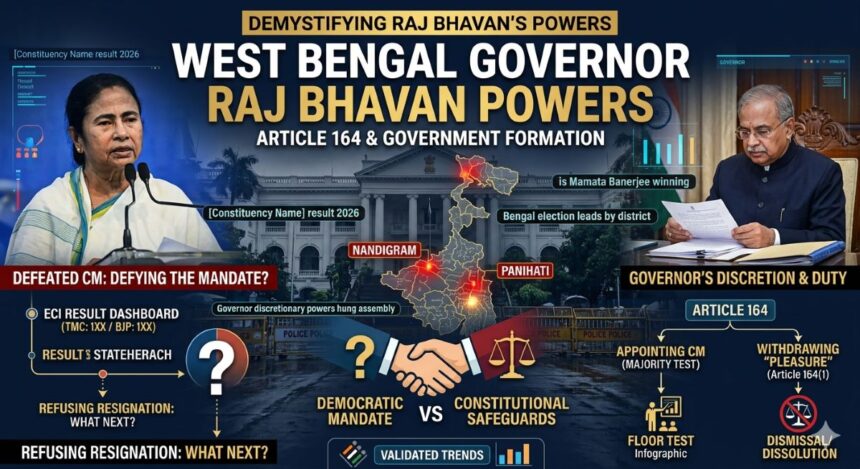
The most visible and critical function within the spectrum of the West Bengal Governor Raj Bhavan Powers is facilitating the formation of a new government. This duty is primarily codified under Article 164 of the Constitution. The text states that the Chief Minister shall be appointed by the Governor.
In standard scenarios, this is a procedural exercise of the West Bengal Governor Raj Bhavan Powers: the Governor simply invites the leader of the single largest party or the pre-poll alliance that possesses a clear majority to take the oath of office. However, when the mandate is fractured, or as in the current unprecedented case, defiance occurs, the true discretionary nature of the West Bengal Governor Raj Bhavan Powers is revealed. The Governor must use their judgment to determine which leader is best positioned to command the confidence of the Legislative Assembly, a central application of the West Bengal Governor Raj Bhavan Powers.

Discretionary Authority in Times of Crisis
Beyond the mandate of Article 164, the Governor possesses “discretionary powers” derived from a combination of constitutional articles (like Article 163) and historical precedents. It is these non-codified aspects of the West Bengal Governor Raj Bhavan Powers that are being actively tested today.
When an incumbent leader fails to secure a majority but attempts to retain office, the West Bengal Governor Raj Bhavan Powers provide mechanisms to ensure that democracy is not held hostage. The Governor has the authority, under the implied limits of their “pleasure,” to set a firm deadline for the defeated government to prove its majority or resign, a crucial safeguard within the West Bengal Governor Raj Bhavan Powers. This authority is not arbitrary but is designed to prevent a structural stalemate and resolve a potential Constitutional Crisis using the specific West Bengal Governor Raj Bhavan Powers.
Dismissal: The Ultimate Use of Raj Bhavan Powers
The most extreme power available to the Governor is the authority to dismiss a Chief Minister and dissolve the Council of Ministers. While this is rarely used and highly controversial, the Constitution, through Article 164(1), makes it clear that ministers serve during the “pleasure of the Governor.”
If a Chief Minister has clearly lost the majority—such as through a certified electoral defeat—but refuses to resign, the West Bengal Governor Raj Bhavan Powers include the authority to officially withdraw that “pleasure.” This act officially terminates the defeated government, preventing a recursive deadlock and ensuring that the West Bengal Governor Raj Bhavan Powers are used to restore legitimate, democratically backed governance. The Supreme Court has consistently upheld that “majority” is the ultimate test, reinforcing the legitimacy of using the West Bengal Governor Raj Bhavan Powers to enforce a democratic outcome when necessary.
Navigating the Future
As the state waits for a resolution, all eyes remain fixed on Raj Bhavan. The ongoing crisis is a reminder that the seemingly ceremonial office of the Governor possesses decisive authority when democratic norms break down. The current Governor is currently consulting with legal experts to ensure that every move made from Raj Bhavan is a precise application of the specific West Bengal Governor Raj Bhavan Powers, designed to honor the will of the voters.
How these West Bengal Governor Raj Bhavan Powers are exercised in the coming days will not only resolve the immediate political crisis but will also establish critical precedents for the future of parliamentary democracy in India, cementing the long-term interpretation of the specific West Bengal Governor Raj Bhavan Powers.

Netai Roy is a journalist and content strategist based in Kolkata, India. With a deep background in digital media, e-commerce, and technology, he reports on daily news, tech updates, personal finance, and emerging digital trends.
Location: Kolkata, West Bengal, India
Focus Areas: Tech News, Business & Finance, Local Developments
Email: contact@netairoy.com