
By News Pulse Desk | April 30, 2026
As West Bengal processes the historic voter turnout of the 2026 Assembly Elections, one critical question dominates political discourse: Did the R.G. Kar sentiment neutralize welfare schemes that have long been the bedrock of the Trinamool Congress (TMC) support base?
For years, the direct cash transfer scheme, Lakshmir Bhandar, has been credited with securing a loyal female vote bank for the ruling party. It was widely seen as an unbeatable electoral masterstroke. However, the 2026 campaign unfolded under the long, harrowing shadow of the 2024 R.G. Kar Medical College tragedy. This horrific event galvanized civil society and women across the state, creating an emotional counter-current.
The fundamental query for analysts now is whether the palpable anger and demand for justice—the powerful R.G. Kar sentiment—crossed class lines to neutralize the direct material benefits of the welfare schemes.
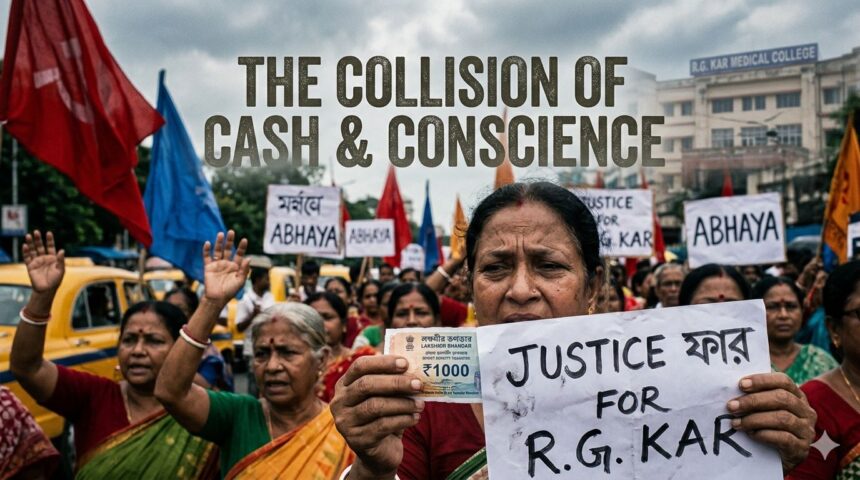
The Collision of Cash and Conscience
The defining tension of this election was the head-on collision between a pervasive sense of gratitude for financial support and a profound, shared vulnerability regarding women’s safety. Lakshmir Bhandar, providing monthly assistance of ₹1,000 to ₹1,200, was the TMC’s central campaign promise, with pledges of substantial increases.

In stark contrast, the opposition, particularly the BJP, focused relentlessly on the R.G. Kar tragedy. By fielding the mother of the victim (referred to emotionally as “Abhaya”) from the Panihati constituency, they forced the issue of safety to the forefront of every conversation. The core of their strategy relied on the hope that the R.G. Kar sentiment neutralize welfare dependency. They wagered that dignity and safety would ultimately outweigh a monthly stipend.
The Silent Voter Theory and Class Divide
The difficulty in gauging this impact lies in the “Silent Voter” phenomenon. It is widely speculated that many women continued to receive Lakshmir Bhandar while privately harbouring immense anger over the state’s handling of the R.G. Kar case. In the privacy of the polling booth, they may have chosen dignity over direct benefit.
Many political commentators argue that while rural voters remained steadfast due to Lakshmir Bhandar, urban and semi-urban women, where the R.G. Kar protests were strongest, were significantly swayed. This leads to the theory that R.G. Kar sentiment neutralize welfare was a localized phenomenon, primarily affecting urban results.
The key debate remains whether a monthly stipend could truly address the visceral fear and anger ignited by the tragedy. The opposition’s constant refrain was designed to ensure that voters asked themselves: “Is Lakshmir Bhandar worth my safety?”
Impact and Implications R.G. Kar sentiment neutralize welfare
Whether R.G. Kar sentiment neutralize welfare definitively or merely made a significant dent will only be clear on May 4. The 92.47% voter turnout indicates a powerful drive on both sides of this emotional divide.
The election results will serve as a profound sociological barometer. They will determine which was stronger in 2026 Bengal: the material security provided by Lakshmir Bhandar or the moral mandate created by the R.G. Kar tragedy.

Netai Roy is a journalist and content strategist based in Kolkata, India. With a deep background in digital media, e-commerce, and technology, he reports on daily news, tech updates, personal finance, and emerging digital trends.
Location: Kolkata, West Bengal, India
Focus Areas: Tech News, Business & Finance, Local Developments
Email: contact@netairoy.com