

By News Pulse Desk | April 30, 2026
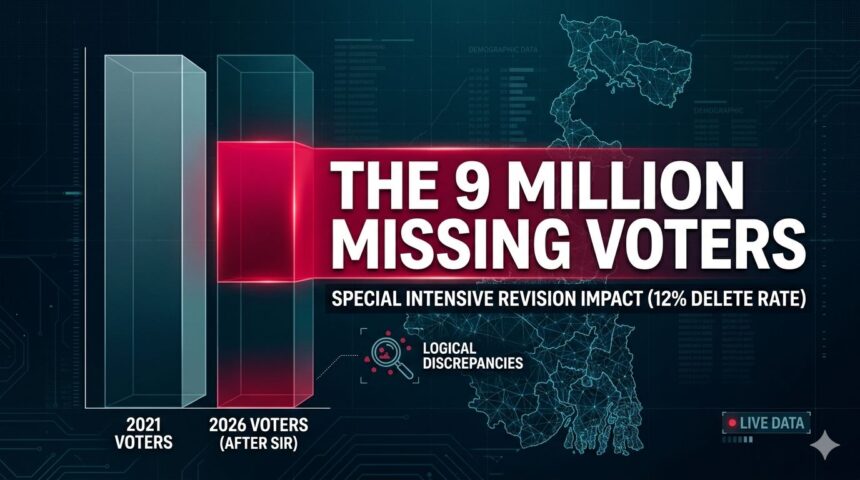
As West Bengal enters the high-stakes “cooling-off” period between polling and the May 4 counting day, a profound statistical shadow hangs over the 2026 mandate. The conversation is rapidly shifting from direct party rivalries to the structural integrity of the process, specifically focusing on the extraordinary phenomenon of the 9 Million Missing Voters.
Prior to the 2026 elections, the Election Commission (ECI) executed a comprehensive Special Intensive Revision (SIR) of the state’s electoral rolls. The SIR was ostensibly designed to purify the rolls, aiming to eliminate “logical discrepancies” and demographic errors. The scale of the cleanup was unprecedented. When the dust settled, approximately 12% of the entire electorate—amounting to roughly the 9 Million Missing Voters—had been deleted from the final lists.
This massive cleanup has ignited a developing constitutional controversy. Political parties across the spectrum are now scrambling to quantify how this roll purge impacted their respective vote banks, particularly in the most closely contested seats.
The Scale and Scope of the SIR Deletions
When the sheer magnitude of the 9 Million Missing Voters first came to light, it sent shockwaves through the state. The ECI defended the process, arguing it was a necessary and rigorous clean-up, removing duplicates and those who had moved or were deceased. However, opposition parties, particularly the ruling Trinamool Congress (TMC), expressed severe reservations, implying that the deletions were geographically or demographically skewed.

The data suggests that the 9 Million Missing Voters were not evenly distributed. Critical districts like the crucial border areas and urban high-rises in North 24 Parganas and Kolkata saw disproportionately high deletion rates. The debate over the 9 Million Missing Voters is inextricably linked to the high-voltage campaign and record turnout, creating a paradox.
The Close Seat Scenario: Could SIR Change the Mandate?
The most significant implication of the 9 Million Missing Voters lies in constituencies where victory margins are often razor-thin. In the 2021 election, dozens of seats were decided by fewer than 5,000 votes. In these “swing constituencies,” the impact of the 9 Million Missing Voters cannot be overstated.
For example, if an average of 30,000 voters were removed from each constituency (amounting to roughly the 9 Million Missing Voters statewide), and those deletions skewed heavily against a particular party, it could decisively tilt the outcome. The statistical anomaly of the 9 Million Missing Voters has introduced an element of deep uncertainty into a mandate that was already difficult to call.
The narrative of the 9 Million Missing Voters is central to the “Exit Poll Paradox.” Pollsters struggling to build accurate models are forced to factor in whether their sampling methods could accurately capture an electorate that was effectively missing 12% of its former self.
Post-Poll Discourse and Constitutional Concerns
Regardless of who forms the government on May 4, the controversy surrounding the 9 Million Missing Voters will dominate post-poll analysis. Legal challenges are almost certain, questioning whether proper verification procedures were followed by the ECI or if the 9 Million Missing Voters were denied their constitutional right without adequate notice.
The issue of the 9 Million Missing Voters also feeds into the “Silent Voter” theory. If a significant percentage of the 9 Million Missing Voters were part of the “silent support base” for a particular party, it further complicates any pre-result prediction.
Conclusion: A Statistical Shadow on May 4
The story of the 9 Million Missing Voters will remain a critical point of friction until the final seat tally is clear. It may even become the lens through which the validity of the entire 2026 West Bengal Assembly Election is viewed. The extraordinary voter turnout and the confusing exit polls will continue to collide with the unavoidable reality of the 9 Million Missing Voters, ensuring that May 4 remains a day of high-stakes statistical tension.
Constituency-Wise Winner List Tracker
Official Special Intensive Revision press release

Netai Roy is a journalist and content strategist based in Kolkata, India. With a deep background in digital media, e-commerce, and technology, he reports on daily news, tech updates, personal finance, and emerging digital trends.
Location: Kolkata, West Bengal, India
Focus Areas: Tech News, Business & Finance, Local Developments
Email: contact@netairoy.com





