

By News Pulse Desk | Published: April 30, 2026
As the curtains fall on the 2026 West Bengal Assembly elections, a new battle has begun: the war of the data points. While voters wait for the official counting on May 4, 2026, the Exit Poll Paradox has taken center stage, leaving citizens and analysts alike questioning who will truly govern from Nabanna.
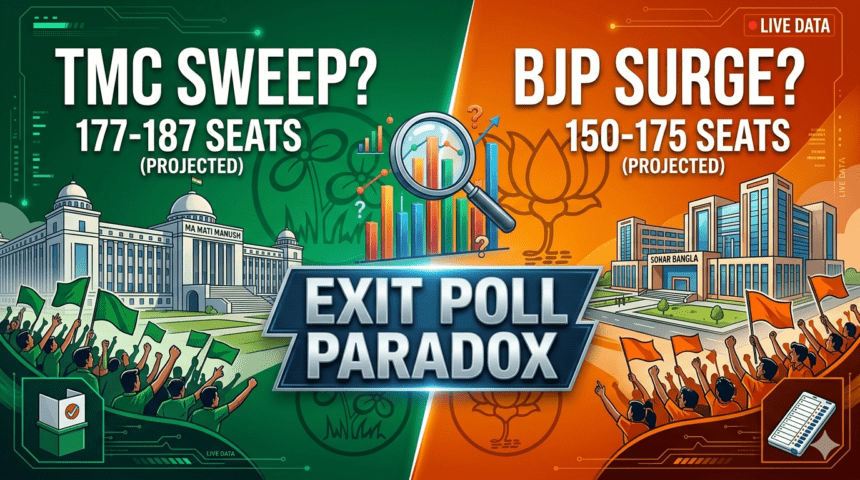
The Exit Poll Paradox is currently defined by a massive divergence in projections. On one side, agencies like People’s Pulse and Janmat Polls are predicting a decisive victory for the incumbent, projecting a TMC sweep with 177–187 and 195–205 seats respectively. Conversely, heavyweights like Chanakya Strategies and P-Marq project a BJP surge that could comfortably cross the 148-majority mark, placing the saffron party between 150 and 175 seats.
The Anatomy of the Exit Poll Paradox
Why is the Exit Poll Paradox so pronounced in 2026? Much of the confusion stems from the 90% voter turnout recorded across the 294 constituencies. In some districts like Purba Bardhaman, turnout even surged past 92%. Historically, such a high volume of voters can signal either a wave of pro-incumbency—voters rushing to protect welfare schemes like Lakshmir Bhandar—or a desperate “silent” push for change.
The Exit Poll Paradox is further complicated by the “Silence Factor.” Axis My India chief Pradeep Gupta noted that in Bengal, up to 60% of voters are unwilling to reveal their true preference to pollsters. This wall of silence creates a vacuum where the Exit Poll Paradox thrives, as different agencies interpret this “quiet vote” through varying lenses.

Methodological Divide: TMC Sweep vs. BJP Surge
| Agency | TMC Projection | BJP Projection | The Verdict |
| People’s Pulse | 178–187 | 95–110 | TMC Sweep |
| Janmat Polls | 195–205 | — | TMC Sweep |
| Chanakya Strategies | 130–140 | 150–160 | BJP Surge |
| P-Marq | 118–138 | 150–175 | BJP Surge |
| Poll of Polls | 145 | 145 | Dead Heat |
The Exit Poll Paradox highlights a sharp rural-urban divide. Pollsters predicting a BJP surge point toward a massive shift in urban areas like Kolkata and Bhabanipur, where anti-incumbency and safety concerns appear to be the primary drivers. Meanwhile, those forecasting a TMC sweep argue that the rural vote bank remains impenetrable due to deep-rooted social welfare dependence.
The “Silent Voter” and the Majority Mark
Ultimately, the Exit Poll Paradox will only be resolved when the Electronic Voting Machines (EVMs) are unsealed. If the BJP surge is real, it would mean a historic 5.5% vote share swing was achieved. If the TMC sweep prevails, it validates Mamata Banerjee’s “Ma Mati Manush” fortress against even the strongest national headwinds.
As we navigate the Exit Poll Paradox, one thing is certain: West Bengal’s 2026 mandate is a bipolar contest where every percentage point matters. The Exit Poll Paradox has set the stage for a high-voltage May 4. Whether it’s a TMC sweep or a BJP surge, the 2026 election will be remembered as the year data met its match in the streets of Bengal.
Check out our live Constituency-Wise Result Tracker for real-time updates on May 4.
Election Commission of India – Official Schedule
Axis My India – Voter Psychology Analysis

Netai Roy is a journalist and content strategist based in Kolkata, India. With a deep background in digital media, e-commerce, and technology, he reports on daily news, tech updates, personal finance, and emerging digital trends.
Location: Kolkata, West Bengal, India
Focus Areas: Tech News, Business & Finance, Local Developments
Email: contact@netairoy.com