

By News Pulse Political Desk | Tuesday, May 5, 2026
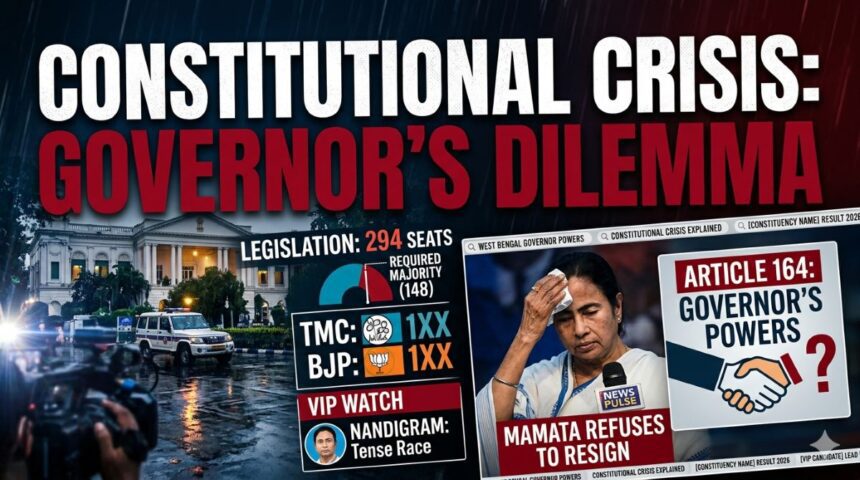
India is witnessing an unprecedented Constitutional Crisis following the declaration of the 2026 Assembly Election results. Reports are emerging that the incumbent Chief Minister, whose party suffered a decisive defeat at the polls, has declined to tender their resignation to the Governor. This defiance has stalled the democratic transition of power and plunged the state into a severe Constitutional Crisis.
The refusal to step down after losing the legislative majority is not just a breach of political convention; it is a direct assault on the core principles of India’s parliamentary democracy. By defying the clear mandate of the people, the outgoing leader has initiated a dangerous Constitutional Crisis that tests the resilience of the nation’s legal framework. This unprecedented Constitutional Crisis has shifted the spotlight away from the electoral victors and onto Raj Bhavan, where the Governor must now navigate unchartered territory to resolve this Constitutional Crisis.
The Core of the Constitutional Crisis
India’s model of governance is based on the Westminster system, where the real executive—the Council of Ministers headed by the Chief Minister—must enjoy the confidence of the popularly elected Legislative Assembly. When a party loses an election, it automatically loses that confidence. The incumbent’s continuing defiance despite lacking the numbers is the definition of a Constitutional Crisis. There is no provision within the Constitution that allows a defeated Chief Minister to linger in office against the clear democratic verdict, making this situation a significant Constitutional Crisis.
The outgoing Chief Minister’s argument for staying on—often citing counting irregularities or alleged biases—is legally untenable in the face of a certified electoral defeat. By transforming a political loss into a structural stalemate, the defeated leader has deliberately created this Constitutional Crisis.

The Governor’s Role in Resolving the Constitutional Crisis
The spotlight is now intensely on the Governor, who acts as the ultimate constitutional referee in the state. In any other circumstance, the Governor’s role in government formation is procedural. However, when faced with a Constitutional Crisis of this magnitude, the Governor must exercise their discretionary powers to safeguard the democratic process. The Constitution has safeguards for such a Constitutional Crisis, ensuring that power flows to those with legitimate democratic backing.
While the Constitution does not explicitly lay out a step-by-step guide for this specific scenario, a combination of established articles and precedents provides the Governor with the tools needed to resolve this Constitutional Crisis.
Constitutional Analysis of the Crisis
The powers to resolve this Constitutional Crisis are primarily rooted in Article 164 of the Indian Constitution.
1. The Principle of Collective Responsibility
Article 164(2) states that the Council of Ministers shall be collectively responsible to the Legislative Assembly of the State. A defeated government, by definition, lacks this responsibility. This breach of a fundamental democratic requirement is why this situation constitutes a clear Constitutional Crisis.
2. Pleasure of the Governor
Article 164(1) states that Ministers (including the CM) shall hold office during the “pleasure of the Governor.” While this “pleasure” is usually bound by the advice of the majority, when a leader clearly loses that majority, the Governor’s pleasure ends. This clause gives the Governor the necessary constitutional authority to terminate the defeated government and resolve the Constitutional Crisis.
Precedents and the Road Ahead: What Happens Next?
India has rarely faced such a scenario, but the Supreme Court has consistently upheld the principle that majority support is absolute and must be demonstrated through numbers. There is no legal ground for a defeated leader to cling to power, meaning this Constitutional Crisis will have a definitive legal outcome.
The Governor is expected to follow a predictable, multi-step process to end this Executive Defiance.
Step 1: Invitation to Resign
The Governor will first send a formal communication to the defeated Chief Minister, citing the election results and inviting them to tender their resignation immediately to facilitate the formation of the new government and end the Executive Defiance.
Step 2: Testing Majority of the New Assembly
If the CM still refuses, the Governor will move forward with the government formation process regardless of the defiance. The Governor will initiate the dissolution of the outgoing assembly (whose term is set to expire shortly) and facilitate the constitution of the new Legislative Assembly. If necessary, a floor test will be conducted for the incoming members to prove majority support.
Step 3: Dismissal
In the most extreme scenario, if the defeated leader still occupies the office, the Governor can officially exercise power under Article 164(1) and withdraw their “pleasure.” The defeated Chief Minister will be officially dismissed, and their cabinet will be dissolved, decisively ending the Constitutional Crisis.
Once this Institutional Deadlock is resolved through one of these mechanisms, the leader of the newly elected majority party will be invited to take the oath of office as the new Chief Minister. The nation is now watching to see how quickly Raj Bhavan acts to safeguard the democratic mandate and end this unprecedented Institutional Deadlock.

Netai Roy is a journalist and content strategist based in Kolkata, India. With a deep background in digital media, e-commerce, and technology, he reports on daily news, tech updates, personal finance, and emerging digital trends.
Location: Kolkata, West Bengal, India
Focus Areas: Tech News, Business & Finance, Local Developments
Email: contact@netairoy.com