

By News Pulse Desk | May 3, 2026
Why Both TMC and BJP Are Claiming a Silent Majority
West Bengal is currently suspended in a high-stakes political vacuum. The intense, months-long campaigning has ceased, the final phase of voting is complete, and the Electronic Voting Machines (EVMs) are sealed in strongrooms. Yet, the noise has not subsided. Instead, it has transformed into a sophisticated, psychological perception war.
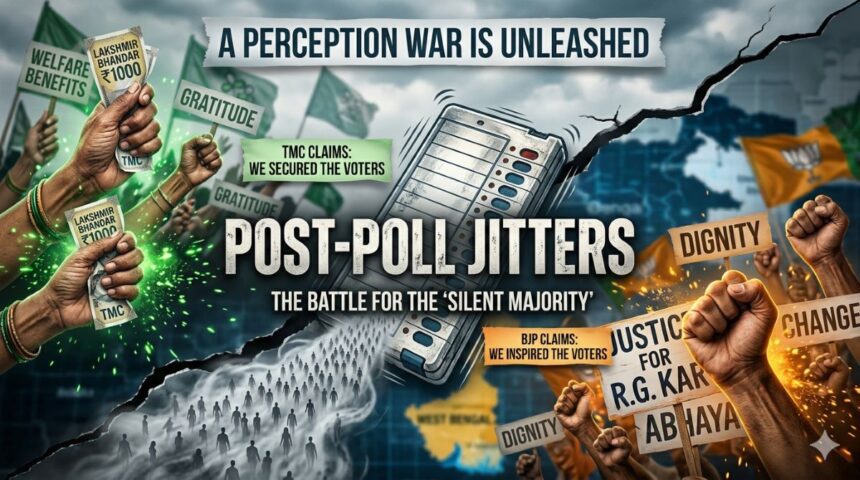
As post-poll jitters set in across the state, both major political camps—the Trinamool Congress (TMC) and the Bharatiya Janata Party (BJP)—have publicly and confidently claimed that the massive, record-breaking turnout benefits them. The focal point of this intense post-voting phase is the elusive, untaggable, and decisive factor known as the Silent Majority.
This intense claims-making process is not random; it is a calculated strategy employed by both sides. Understanding why both the TMC and BJP claim this Silent Majority is crucial to navigating the confusing discourse that will dominate Bengal until counting day on May 4.

The Psychology of the Perception War
The period between the final vote and the first result is defined by anxiety and uncertainty, often manifesting as intense post-poll jitters for party leadership, workers, and even voters. The primary reason both parties claim a Silent Majority is to manage this anxiety within their own ranks. By projecting confidence, they prevent morale from crashing among their cadre, which is essential to ensure they remain mobilized and vigilant for the critical counting day logistics.
Furthermore, this perception war is a battle for the narrative. In a state as politically volatile as Bengal, controlling the perception of who is winning creates momentum. By claiming the Silent Majority, parties aim to influence the neutral observers, media narratives, and even potentially pressure the administrative machinery involved in the counting process.
TMC’s Narrative: The Welfare Defense Base
The ruling TMC’s claim to the Silent Majority rests on the perceived invincibility of its massive welfare infrastructure. Schemes like Lakshmir Bhandar have created a loyal, dependent female vote bank that pollsters historically find difficult to accurately capture.
Senior TMC leaders are privately dismissing the “R.G. Kar sentiment” anti-incumbency narrative, arguing that the true Silent Majority in rural and semi-urban Bengal prioritize the tangible material security provided by direct cash transfers. They contend that this quiet, grateful electorate turned out in droves to protect their benefits. The TMC’s confidence is built on the belief that this welfare-statism creates an immovable Silent Majority that overrides any localized social anger, a theory they also rely on in the confusing Exit Poll Paradox.
BJP’s Narrative: The Anti-Incumbency Surge
Conversely, the BJP’s confident claim to the Silent Majority is rooted in the overwhelming voter turnout, particularly in regions that saw major social protests, such as Sandeshkhali. The saffron party interprets the historic participation not as support for the status quo, but as a quiet, powerful urge for change.
The BJP’s strategy relies heavily on the “Silent Voter” theory we have explored previously: individuals who accepted TMC welfare benefits but privately harbored immense anger over issues of corruption, safety (highlighted by the R.G. Kar tragedy), and perceived institutional decline. They argue that this moral anger created a massive, subterranean Silent Majority that used the ballot box as their only safe avenue for expression. The BJP believes this quiet resentment is the key to finally breaching the TMC’s urban and rural strongholds.
Post-Poll Jitters and the Final Verdict
The paradoxical nature of this phase is that both narratives seem plausible. The conflicting signals have intensified the post-poll jitters, as the data—the final numbers—could validate either strategy.
The Silent Majority, by definition, is only heard on counting day. Until then, both parties will continue to weaponize the term in their perception war. The intense claims-making is a testament to the fact that 2026 Bengal was not a single mandate, but a complex intersection of competing forces.
May 4 will bring clarity. Only then will we know which Silent Majority was real: the one grateful for welfare or the one furious for justice. The official Election Commission of India results portal will provide the definitive data to end the speculation and the perception war once and for all.

Netai Roy is a journalist and content strategist based in Kolkata, India. With a deep background in digital media, e-commerce, and technology, he reports on daily news, tech updates, personal finance, and emerging digital trends.
Location: Kolkata, West Bengal, India
Focus Areas: Tech News, Business & Finance, Local Developments
Email: contact@netairoy.com